Execution
Real work, on a real board. The team runs the standard agile machinery — and humans climb the same staircase the agents do.
Real work you can watch — not a black box
Your work runs on a real board: planned, gated, and landed in increments you can watch — not a system that swallows a request and emits a result. Every item on the board has an owner, and a coordinator drives each cycle: chasing results, checking work in, and surfacing anything off-track to you.
You hold the gates. Ratify, wait, or redirect happen at named decision points — you own the gates around the work, never the work itself. And you keep your existing tools: the Banister works with your JIRA or your own board, so the work stays where your team already tracks it. No move to a new stack to get any of this — another way we fit to you instead of making you change.
The portfolio board
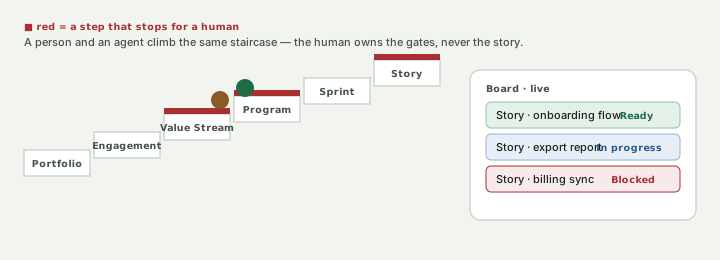
Work isn't chat — it's tracked on a portfolio board that steps down through the tiers we build on:
A client's engagement is their release train.
What each tier actually is
- Portfolio — everything, across all your engagements. The top-down view.
- Engagement — one client or one initiative. Your Banister lives here; in agile terms, your release train.
- Value stream — a long-lived line of value inside an engagement (a product, a program area).
- Program increment — a time-boxed block of work with a goal, made of several sprints.
- Sprint — a one-to-two-week cycle: work planned, done, reviewed.
- Story / task — the actual unit of work — typed, with its preconditions and its derived blocked/ready state.
- Work items carry their own truth. Each item has a fixed type, explicit preconditions, and derived state — "blocked" and "ready" are computed from dependencies, not hand-set and left to drift. The board can't misreport what's actually unblocked.
- Humans hold the gates. Ratify, wait, or redirect happen at named decision points. The human owns the gates around a story — never the story itself.
The teams on the board
Every item on the board has an owner — a persona in its lane — and a coordinator persona drives the sprint: chasing results, checking work in, surfacing anything off-track to the human. The board is where the workforce (Layer 1), the governance gates (Layer 2), and the coordination bus (Layer 5) meet and become visible progress.
Two modes, one board
The team operates in explicit modes — planning versus execution — so it's always clear whether the team is shaping the work or driving it to done. The switch is deliberate and recorded, not ambient.
Integration with your board
The Banister reads and writes your JIRA or your own board through structured integration, so the work stays where your team already tracks it. The typed items and the derived blocked/ready state live in the Banister's own board today, with your board as the shared work surface.